
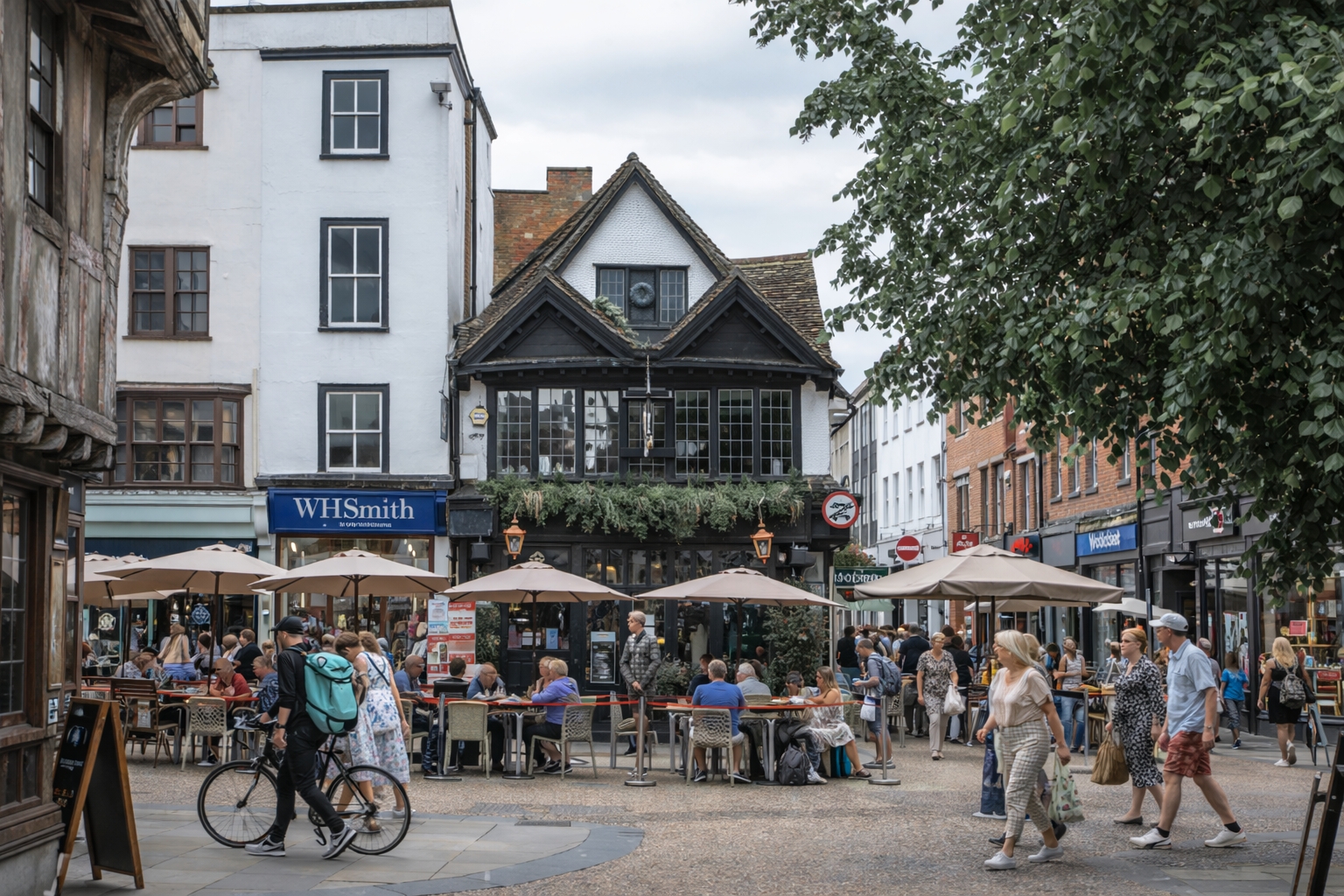

Health, housing, and hospitality are reshaping what Town Centres are for. Most place managers are still measuring the old version.
Something significant is happening to UK Town Centres, and it is not the thing most dashboards are tracking.
Footfall is up. Year-on-year growth has been positive across every region. On the surface, that looks like recovery – and in part, it is. But the visitors coming back are not doing what they used to do. They are not coming to shop in the way they once did. They are coming to eat, to exercise, to see a GP, to sit in a park, to work from a café, to meet someone for brunch. The town centre they are visiting is fundamentally different from the one being measured.
And that change in profile needs to be considered and understood to allow managers to provide what is needed for the future, not the past.
The high street has already changed. The metrics have not.
Walk down any active UK high street and the shift is visible. Health centres and GP surgeries have moved into former retail units. Gyms and wellness studios occupy spaces that once held department store concessions. Cafés, restaurants, and independent food businesses have multiplied. Green spaces and public seating have expanded. Housing developments are bringing thousands of new residents into town centre footprints.
This is not a temporary response to vacant units. It is a structural transformation in what Town Centres are for. They are becoming mixed-use destinations – part healthcare, part hospitality, part residential, part leisure, part retail. The shopping centre model is over. What has replaced it is more complex, more varied, and arguably morevaluable to communities.
But most Town Centre performance reporting still behaves as if the primary question is: how many people walked past the shops?
That question made sense when retail was the dominant function. It does not make sense when half the ground-floor units serve a different purpose and the fastest-growing visitor segment is there for a flat white and a physiotherapy appointment.
Hospitality is not a nice-to-have. It is the new anchor.
In the old model, a department store or a major chain was the anchor tenant – the draw that pulled visitors in and kept them moving through the rest of the offer. That model has largely collapsed. What has replaced it, in many towns, or at least enhanced it, is hospitality.
Eating and drinking out is now one of the primary reasons people visit a Town Centre. Not as a secondary activity after shopping, but as the purpose of the trip. A cluster of good independent restaurants, a weekend brunch culture, a regular food market – these are the things that pull people in and keep them there.
The data backs this up. Dwell times in Town Centres with a strong hospitality offer are consistently longer. Repeat visit rates are higher. Visitor spend is more resilient to the seasonal swings that flatten retail-dependent centres.
Yet hospitality is still treated as secondary in most Town Centre strategies – a nice addition rather than a core driver. If you are measuring success by retail footfall and your strongest asset is a restaurant quarter, the metric is not telling the story of what is actually working.
Housing growth will change everything – and most places are not ready to measure it
The government’s housebuilding programme will bring significant numbers of new residents into town centre catchments over the coming years. That is both an opportunity and a challenge, but it is also a measurement problem that very few places have thought about.
New residents do not behave like existing ones. Their travel patterns are different. Their relationship with the town centre is unformed. They may not know the market runs on Saturdays. They may default to driving to a retail park because they have not yet discovered the independent offer on the high street. They may use the GP surgery but never visit the café next door.
For place managers, the question is not simply whether footfall goes up when new housing is occupied – it almost certainly will. The question is whether those new residents are integrating into the town centre economy in ways that sustain it. Are they becoming regulars? Are they spending locally? Are they using the full range of what the town centre offers, or just the pharmacy and the supermarket?
If you cannot track personas, origin, frequency, dwell time, and movement patterns for different visitor segments, you will not know the answer until it is too late to do anything useful about it.
You cannot manage a mixed-use destination with a single metric
This is the core issue. Town Centres have become multi-functional places serving health, housing, hospitality, leisure, and retail simultaneously. But most are still governed by a performance framework designed for a single-function space.
A Town Centre where footfall is flat but dwell time is up, hospitality spend is growing, GP surgery visits are steady, and green space usage has doubled is not struggling. It is succeeding – just not in the way a footfall counter can recognise.
A Town Centre where footfall has risen ten per cent because a new housing development opened but spend per visit has dropped, repeat rates are low, and visitors are concentrated in one street while the rest empties out is not thriving. The headline number looks healthy. The underlying picture does not.
Managing a modern Town Centre requires layered intelligence: movement data to understand how people flow through the space, spend analytics to see where economic value sits, catchment analysis to know where visitors come from and how that is shifting, dwell time to distinguish a passing visit from a meaningful one, and demographic insight to understand who is using what and why.
Footfall is part of that picture. It is not the picture.
Place Informatics helps Town Centres, BIDs, Local Authorities, and Destination Managers understand the full picture of how their places are actually being used – not just how many people showed up. Place360 brings together footfall, movement, spend, dwell time, catchment, and visitor persona data so you can manage a mixed-use destination with the intelligence it requires. If your Town Centre has changed but your reporting has not, we’d welcome the conversation.
Place Informatics provides location analytics, footfall intelligence, and behavioural insights for UK Town Centres, BIDs, Local Authorities, National Parks, and Tourism destinations.