


For destination managers, the ability to make evidence-based on who is and who is not visiting is critical.
Which postcodes should you be targeting your facebook marketing? What impact on spend do your overnight stay visitors have? Who should you be marketing to, to attract more high spenders? What share of day visitors are you capturing compared to your neighbouring DMO? How do visitors move across your destination from country park, to beach and then to town centre? What attractions are driving visits to your DMO?
These are all questions which can be answered by PlaceIQ Tourism.
We want to introduce the powerful combination of spend, mobility and overnight stay data and explain exactly what it can do for your destination.
What Is PlaceIQ Tourism?
PlaceIQ Tourism is the only UK data platform specifically created for destination managers which combines spend, overnight stay and mobility data powered by over 13 million unique phones.
By analysing actual anonymised and aggregated GPS data (not BT network data) from millions of devices across the country, we provide granular behaviour data down to an accuracy level of 10m and home origin postcodes for targeted marketing. By combining spend data from credit and debit cards and short term let occupancy data from AirBnB and booking.com all integrated with our weather, attraction, visits, transport flows and digital marketing insights – you have a single, joined-up view of your destination
No longer rely on surveys, ticket sales, or voluntary data submissions.
What Data Does PlaceIQ Tourism Provide?
PlaceIQ delivers nine key types of insight:
Day Visitor Volumes
See how many tourists visited your destination, town centres and attractions each day. Compare against local and worker visits.
Understand what share of bank holiday day visits your destination captured compared to neighbouring attractions. Measure the impact your food festival has had on activity across your destination and what type of visitors the event appealed to.
Move from counting footfall volumes to understanding what the impact of an event was on retail, leisure and attractions in your destination.
Overnight Stay and Accommodation Booking Volumes
Overnight stays are one of the strongest indicators of tourism success.
They reveal not just whether visitors arrive, but whether a destination is compelling enough to retain visitors, generate value, and sustain the local economy. For destination managers, analysing overnight stay volumes shifts focus from activity to impact.
Identify how compelling your destination is, how compare against competitors and whether your offer supports multi-day experiences. Low overnight volumes often signal gaps in accommodation, weak evening economy and poor connectivity between attractions.
Evidence that stands up to scrutiny; Being able to show growth in overnight stays, increases in average length of stay and improved conversion from visits to stays.
Visitor Spend
High footfall does not automatically mean high benefit. Our spend insight is derived from a large, anonymised sample of debit and credit card transactions. While it is not a census of every pound spent, this sampled card‑based view remains one of the most powerful indicators of tourism value.
Our spend data allows destination managers to see , which visitor types spend more or less, where spend concentrates or disperses and how spending changes by season, area, or intervention.
When combined with GPS movement data and overnight stay insight, sampled spend data becomes a decision‑grade signal that helps destination managers:
grow higher‑value tourism without increasing congestion, target investment where it delivers the greatest return, adapt strategy confidently as markets and behaviour change and demonstrate progress clearly to boards, funders, and partners.
Precision Visitor Marketing
PlaceIQ tourism reveals which postcodes your visitors originate from. Postcodes turn “visitor origins” into actionable geography. Instead of knowing “Visitors come from the South East” You know:
- Which neighbourhoods
- Which travel corridors
- Which drive‑time catchments
- Which rail‑accessible zones
With postcode‑level insight destination managers can target:
- Postcode sectors with high propensity to visit
- Lapsed markets that need reactivation
- Emerging markets showing growth
Campaigns can be:
- Geo‑fenced
- Budget‑optimised
- Phased by distance and likelihood
That is the difference between describing demand and targeting it.
Mode and Purpose of Travel
Destinations are used by three distinct groups — workers, locals, and tourists — who also arrive and move around using different modes of travel (car, rail, public transport, walking).
Understanding who is moving and how they are moving using GPS data gives destination managers the insight needed to manage pressure fairly, grow tourism value, and plan access and infrastructure effectively.
GPS data distinguishes between:
Workers – habitual, weekday, commute‑led movement
Locals – frequent, regular, non‑leisure activity
Tourists – non‑routine, exploratory, discretionary behaviour
Gives destination managers the clarity to manage congestion fairly, plan access intelligently, target tourism marketing precisely, enhance visitor experience, and grow tourism value sustainably.
Benefit: Tourism impact is measured accurately and credibly, without being inflated by commuting or resident activity.
Visitor Personas
People do not visit destinations because of regions or headline statistics. They visit because a place fits their lifestyle, matches their motivations or feels relevant to them. Instead of saying we attract visitors from the Midlands, PlaceIQ Personas allows you to say we attract ‘urban couples interested in food, culture and events’.
By linking personas to postcodes, travel distances, behaviour patterns we help you invest your limited marketing spend in more high value segments and reduce spend on low-propensity audiences.
Personas allow destinations to target smarter, message better, spend efficiently and clearly demonstrate marketing impact.
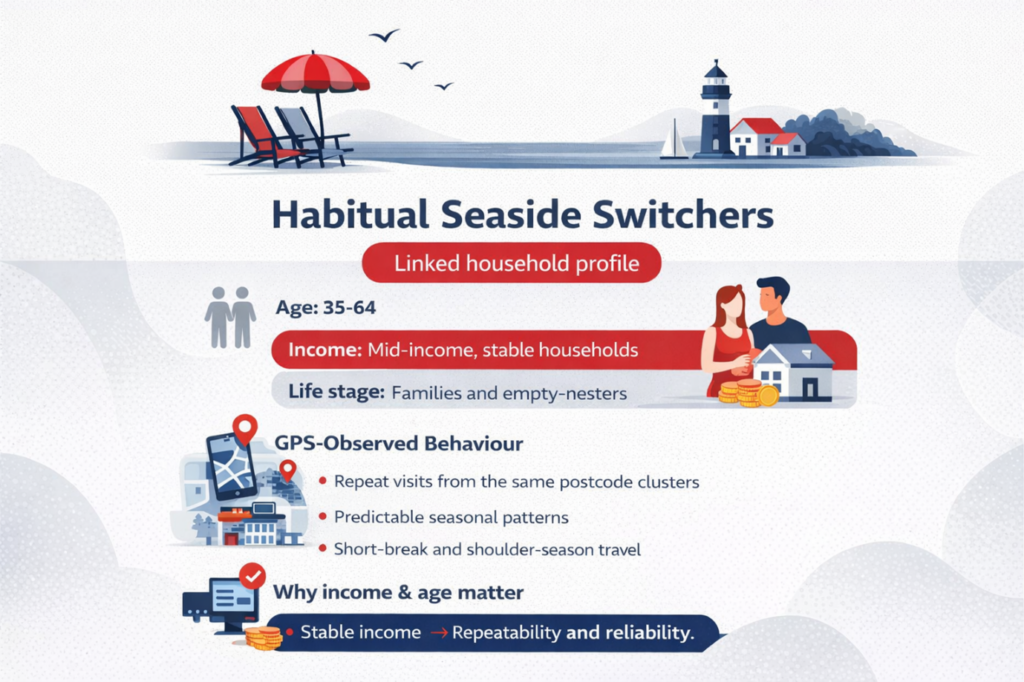
Visitor Incomes and Age Groups
The breakdowns of visitors by age profile and household income decile allows destinations to prioritise visitors from households with higher discretionary spend, Focus on trips that deliver longer stays and wider spend, shift strategy from volume growth to value growth. We link household income and age to GPS derived personas to support you in attracting the right households, at the right time, for the right value.
Visitor Movement
Visitor numbers and footfall only show presence. Our GPS movement data shows:
- Which places visitors actually use
- How different areas connect
- Whether visitors stay in one hotspot or explore widely
Knowing how visitors move around a destination is just as important as knowing how many arrive.
GPS‑derived movement insight shows what visitors actually do once they arrive — which places they use, how they connect experiences, and where opportunity or pressure really sits. For destination managers, this turns tourism from something that is measured into something that can be managed.
Understanding visitor movement using GPS data allows destination managers to see how visitors actually experience the place — enabling smarter dispersal, better investment decisions, stronger local economic benefit, more effective marketing, and confident long‑term destination management.
Attraction Visits
Understanding how visitors move (GPS data) and what they spend (spend data) around attractions gives destination managers a complete, practical view of attraction performance — not just how busy places are, but how much value they generate and how they contribute to the wider destination.
Together, these datasets turn attraction insight from operational reporting into strategic intelligence.
GPS data shows Who visits attractions (tourists, locals, workers), How often they visit, How long they stay, How attractions fit into wider visitor journeys.
Spend data shows whether visits translate into economic value, how much is spent in and around attractions and the differences in value between visitor types.
You can distinguish between Attractions that are busy but low value and attractions that attract fewer visitors but generate high spend visitors to the destination
This supports better prioritisation and support decisions.
Benchmarking
Headline metrics often suggest success because destinations are busy.
Benchmarking with GPS, spend and overnight stay data allows managers to see:
- Whether visitors stay overnight or just pass through
- Whether overnight stays translate into longer dwell and higher spend
- How destination value compares like‑for‑like with peers
You can clearly identify whether your destination is:
- High‑volume but low‑yield
- Short‑stay dominated
- Or outperforming peers on value per visit and per night
Power of Integrated Visitor Insights
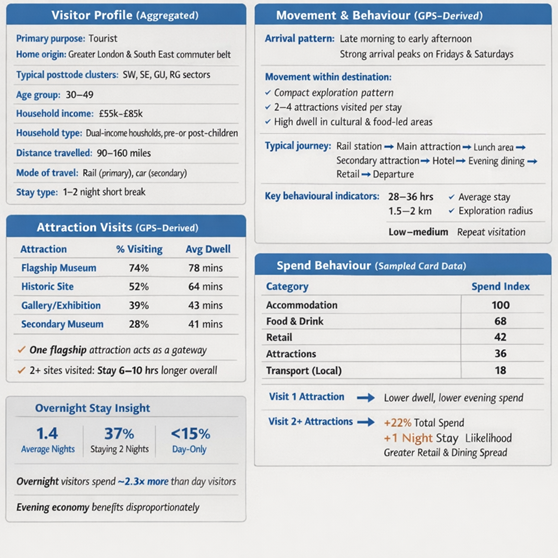
Below is a real world example of how combining GPS mobility, credit and debit card spend overnight accommodation booking data provides a single integrated view which enables
- Identification of high-value household segments
- Understand which attraction types drive visits and spend
- Targeting of postcode clusters most likely – to stay overnight
- Design itineraries and signage that encourage multi attraction visits
- Evidence the value growth which comes from behaviour change not volume growth
The data shows high‑value, low‑pressure visitor cohort. They stay overnight, engage with multiple attractions, and generate above‑average spend across accommodation, food, and retail. Our data shows that encouraging secondary attraction visits within this segment delivers additional value without increasing congestion.
Ready to Identity High Value Visitors?
Book a demo to see how GPS movement data, sampled debit and credit card spend, and overnight stay insight combine to show which visitors generate the most value, which attractions and journeys drive spend, and where revenue opportunities are being missed.
In a concise, commercially focused walkthrough, you’ll see how leading destinations use this intelligence to increase yield, extend stays, improve marketing ROI, and maximise the return on existing assets—without increasing visitor volumes.
Book a demo today and start turning visitor data into measurable commercial results.